
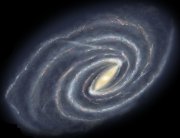
 If you are new to this site, you may want to start with the section on the basic plan of the Milky Way and take a look at some of the other chapters in Our Galactic Region. This is not only a guide to the maps on this site and how they were constructed, but includes a growing amount of information about the key scientists mapping the Milky Way and some of their most exciting discoveries.
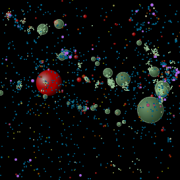 Images, descriptions, and references to the scientific literature are available for many objects, containing a vast amount of information on objects found within about 10 thousand parsecs (some 30 thousand light years) from our Sun. The site includes guides to the Sharpless,
Gum, and
RCW nebulae. These deep sky objects are now within the reach of many CCD-equipped amateur telescopes.
Images, descriptions, and references to the scientific literature are available for many objects, containing a vast amount of information on objects found within about 10 thousand parsecs (some 30 thousand light years) from our Sun. The site includes guides to the Sharpless,
Gum, and
RCW nebulae. These deep sky objects are now within the reach of many CCD-equipped amateur telescopes.
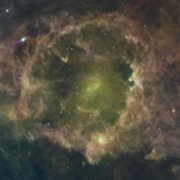 In addition to maps and images, there is the beginning of a guide to the Milky Way: Our Galactic Region as well as first drafts of a Commentary on the Galactic Plane and a commentary on the whole sky as seen in hydrogen-alpha, the frequency of ionised hydrogen gas.
You can see images and descriptions of the objects in the
Sharpless,
Gum and
RCW catalogs, as well as an integrated catalog of 733 hydrogen-alpha nebulae from many sources that contains useful data for astro-photographers. You can also visit a gallery of larger unusual and often beautiful images, Strange New Worlds.
To learn more about the Milky Way galaxy, visit Richard Powell's Atlas of the Universe, Winchell Chung's 3-D Starmaps and Dean Salman's Images of the Sharpless Catalog.
This image was created using the POSS-II/UKSTU data of the
Digitized Sky Survey
using the process described here.
According to my correspondence with the Space Telescope Science Institute
I am allowed to use the POSS-II/UKSTU data to
create and display images for non-commercial purposes
so long as I include this fine print taken from the DSS site:
The Digitized Sky Surveys were produced at the Space Telescope Science Institute under
U.S. Government grant NAG W-2166. The images of these surveys are based on photographic
data obtained using the Oschin Schmidt Telescope on Palomar Mountain and the UK Schmidt Telescope.
The plates were processed into the present compressed digital form with the permission of these institutions.
The Second Palomar Observatory Sky Survey (POSS-II) was made by the
California Institute of Technology with funds from the National Science Foundation,
the National Geographic Society, the Sloan Foundation, the Samuel Oschin Foundation,
and the Eastman Kodak Corporation.
The UK Schmidt Telescope was operated by the Royal Observatory Edinburgh,
with funding from the UK Science and Engineering Research Council
(later the UK Particle Physics and Astronomy Research Council), until 1988 June,
and thereafter by the Anglo-Australian Observatory. The blue plates of the southern Sky Atlas
and its Equatorial Extension (together known as the SERC-J), as well as the Equatorial Red (ER),
and the Second Epoch [red] Survey (SES) were all taken with the UK Schmidt.
The "Second Epoch Survey" of the southern sky was made by the
Anglo-Australian Observatory (AAO) with the UK Schmidt Telescope.
Plates from this survey have been digitized and compressed by the ST ScI.
The digitized images are copyright © 1993-5 by the Anglo-Australian Observatory Board,
and are distributed herein by agreement.
The "Equatorial Red Atlas" of the southern sky was made with the UK Schmidt Telescope.
Plates from this survey have been digitized and compressed by the ST ScI.
The digitized images are copyright © 1992-5, jointly by the UK SERC/PPARC
(Particle Physics and Astronomy Research Council,
formerly Science and Engineering Research Council) and the Anglo-Australian Telescope Board,
and are distributed herein by agreement.
The compressed files of the "Palomar Observatory - Space Telescope Science Institute Digital Sky Survey"
of the northern sky, based on scans of the Second Palomar Sky Survey are copyright © 1993-1995 by the
California Institute of Technology and are distributed herein by agreement.
The compressed files of the "Palomar Observatory - Space Telescope Science Institute Digital Sky Survey"
of the northern sky, based on scans of the Second Palomar Sky Survey are copyright © 1993-1995
by the California Institute of Technology and are distributed herein by agreement.